Transformers are multi-million-dollar assets that form the backbone of any modern electrical grid. As a grid asset owner, you rely on them to manage voltage levels for efficient transmission and safe local distribution, with liquid-filled transformers playing a central role due to their proven insulation and cooling performance in high-voltage applications.
A single transformer failure can often lead to widespread outages, significant financial losses, and serious safety risks. It is crucial for you to know about ensuring the reliability of such a vital asset, especially when insulation health directly influences performance and lifespan.
The answer lies in rigorous testing.
Before any transformer leaves the factory floor, it must undergo a comprehensive suite of strictly regulated tests. These procedures verify construction quality and confirm transformer performance metrics against your specific engineering requirements.
In this article, learn the essential transformer testing methods and the global standards that currently govern them. We will also cover the steps required to scientifically validate the structural integrity of your critical energy infrastructure before energization.

Why is transformer testing non-negotiable?
For a project developer, transformer testing offers essential protection against major failures in real-world situations, particularly for liquid-filled transformers operating under thermal and dielectric stress. Here is why it is non-negotiable for you:

- Ensures Project Reliability and Uptime: You cannot afford unexpected failures in critical grid applications where uptime directly impacts your revenue stream. Rigorous testing identifies potential manufacturing defects before installation. This proactive approach prevents costly interruptions and ensures your project meets its availability targets from day one.
- Validates Asset Quality and Performance: Verification proves the unit matches every technical spec in your contract. It confirms that efficiency ratings are real and not just estimates. You gain proof that the asset works exactly as designed before it ever handles a real load.
- Guarantees Safety and Compliance: If insulation systems are compromised or faulty, high-voltage equipment poses serious risks to personnel and surrounding infrastructure. Standardized testing of transformers checks that all safety gaps meet strict industry codes. This keeps your workforce safe and significantly lowers your legal liability.
- Protects the Capital Investment: Transformers take up a large portion of your project budget and need protection against early failure. Testing the unit before it ships ensures you get exactly what you paid for. This protects the equipment's lifespan and maximizes your long-term return.
The three core categories of transformer testing
The industry divides testing protocols into three distinct categories based on necessity and frequency of application. You must understand the specific purpose of each category to define the right scope for your project assets.
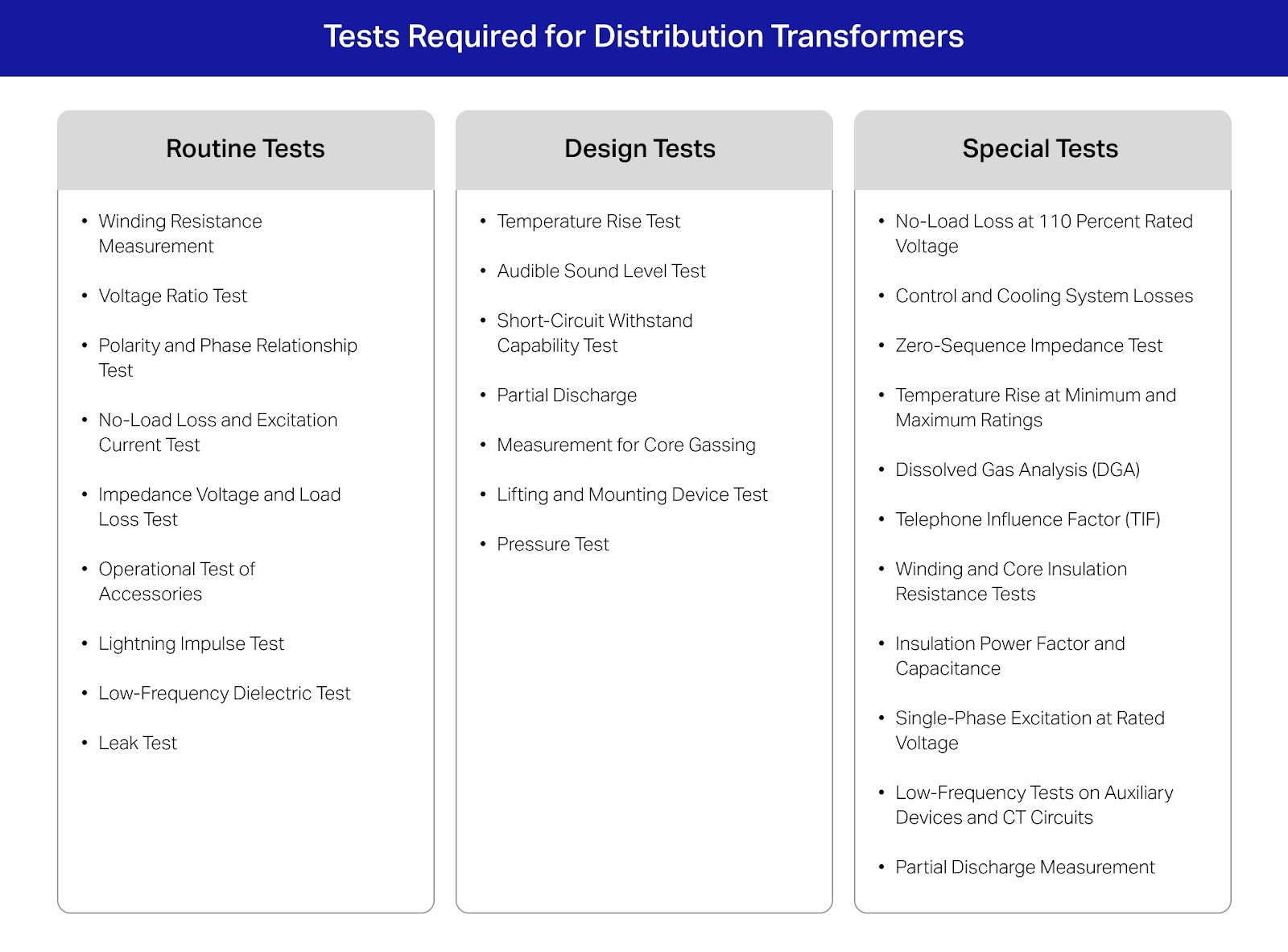
Key Routine Tests
These mandatory procedures are performed on every manufactured transformer. They confirm basic functionality and safety for every serial number.
- Winding Resistance Measurement: This test measures the DC resistance of the windings to check for loose connections or broken strands. You use this data to calculate load losses and determine the temperature rise.
- Voltage Ratio Test: This test confirms that a distribution transformer correctly converts primary voltage to the intended secondary voltage as per its nameplate rating. By comparing the measured voltage ratio with the specified ratio, this test verifies proper winding connections, correct tap changer settings, and absence of turn-to-turn faults.
- Insulation Resistance (Megger) Test: This evaluates the condition of the insulation system between windings and from windings to the ground. You rely on this to detect moisture ingress or contamination within the insulation structure.
- Vector Group Test: This confirms the phase displacement and polarity relationships between the high-voltage and low-voltage terminals. It ensures that the transformer can operate in parallel with other units in your system.
- Lightning Impulse Test: This test simulates the impact of a lightning strike or switching surge on the transformer insulation system. It confirms the unit can withstand high-voltage transients without suffering dielectric breakdown.
Why Routine Tests Matter: You must conduct these mandatory checks to confirm every unit is safe before it leaves the factory. They prove the basic construction meets operational standards before you ever turn the power on. This step prevents the nightmare of immediate failure the moment you install the asset.
Design Tests
Manufacturers do not perform type tests on every unit produced. They conduct them on a single prototype to validate the integrity of a specific design.
- Temperature Rise Test: This test verifies that the transformer cooling system maintains the temperature rise within specified limits at full load. It proves the thermal design can handle the heat generated during operation.
- Short-Circuit Withstand Test: This rigorous test demonstrates the transformer's mechanical ability to withstand the immense forces of a short circuit. It confirms that the internal clamping structure remains intact under stress.
Why Type Tests Matter: These stress tests validate the engineering design itself, not just the quality of one transformer. They prove that the specific transformer model can handle extreme heat and sudden voltage spikes without failing. This gives you confidence that the design concept is robust enough for real-world grid events.
Special Tests
Special tests fall outside standard routine or type test protocols. You must request these specific procedures to validate unique characteristics critical to your application or site conditions.
- Noise Level Measurement: This test measures the audible sound produced by the transformer core and cooling fans during operation. You need this to ensure compliance with local noise ordinances in residential or urban areas.
- Partial Discharge Test: This test detects minute electrical discharges occurring within voids or defects in the insulation system. Identifying these early prevents progressive insulation degradation that leads to catastrophic failure over time.
- Dissolved Gas Analysis (DGA): This test involves taking a sample of the insulation liquid from a transformer and analyzing the dissolved gases within it. It identifies critical gases generated by incipient faults, detecting early issues that could lead to major breakdowns in the future. Based on these results, asset owners can plan suitable preventive maintenance to ensure an uninterrupted power supply and prevent costly transformer failures.
Why Special Tests Matter: These tests handle specific risks unique to your project site. They provide a deeper look into the transformer health and help you meet strict local rules, like noise limits in cities. This proactive step helps avoid unique operational problems down the road and also helps you with a benchmark to calibrate future results done while the transformer is in service.
Navigating the power transformer testing global standards: IEEE vs. IEC
Transformer testing follows globally established standards to ensure uniform performance. You must choose the right standard to match your regional grid needs and operational goals.
- IEEE: This remains the dominant standard for projects located across North America and select international markets. The IEEE C57 series provides the standard requirements for test procedures and performance tolerances. IEEE standards focus on meeting specific user needs and handling robust electrical loads.
- IEC: This is the most common standard used globally, especially throughout Europe, Asia, and the Middle East. The IEC 60076 series is the primary document governing power transformers and their testing. IEC standards prioritize strictly defined ratings and standardized design classes.
The critical milestone: The Factory Acceptance Test (FAT)
The Factory Acceptance Test is the last step in the manufacturing process. It serves as a formal event in which all specified routine tests are performed on the completed transformer before the factory approves shipment.
This test is a crucial quality assurance checkpoint before the unit arrives at your site. The FAT provides documented and verifiable proof that the asset fully complies with all technical specifications and performance standards outlined in your contract.
You should view the FAT as your final opportunity to catch potential issues while the unit is still with the manufacturer. Addressing issues here avoids costly field modifications and ensures seamless energization upon arrival at the final destination.
Smart buyer’s checklist: Ensuring integrity
In addition to the standard tests, you should enforce these specific protocols for transparency:
- Clarify Acceptance Criteria: Define pass/fail margins in your contract before manufacturing begins to avoid disputes later. You must ensure that the specific tolerances for losses and impedance are agreed in writing.
- Check Calibration Certificates: Ensure lab equipment used for FAT has valid, up-to-date calibration documentation. You cannot trust the accuracy of test results if the measuring instruments themselves are out of spec.
- Define Retesting Protocols: Establish clear rules for what happens if a test fails during the FAT process. You should request a root cause analysis report before permitting any retesting of the unit.
- Verify Visual Inspection: Do not rely solely on electrical data to determine the health of the asset. You must physically inspect for oil leaks plus paint defects before granting final approval for shipment.
- Confirm Testing Sequence: Ensure dielectric tests are performed in the correct order to stress the insulation properly. Performing these out of sequence can sometimes hide potential defects that would otherwise appear during testing.
Testing as the foundation of trust
In large-scale energy projects, asset quality cannot be left to assumption. A power transformer sits at the core of your operations, and any failure carries significant financial and operational risk. Securing complete confidence before energization is essential to protect your investment.
Rigorous testing under globally recognized standards such as IEEE and IEC offers the most reliable way to assess transformer health. This process turns complex engineering into a trusted component for your grid. It ensures your infrastructure is ready to deliver reliable power for decades to come.
At Ayr Energy, we validate this trust through rigorous testing at our NABL-certified state-of-the-art facility. Backed by a team with more than 250 years of combined engineering expertise across the team, we ensure every unit meets ANSI/IEEE safety protocols before it leaves the factory floor. We deliver audit-ready assets that are engineered to meet your specific grid requirements without compromise.
Contact our engineering team to explore our testing capabilities and secure your next project.