For utility-scale solar developers, 2026 marks a critical shift in how you establish safe harbor for solar projects under the Investment Tax Credit (ITC). The enactment of the One Big Beautiful Bill Act (OBBBA) and the subsequent IRS Notice 2025-42 have fundamentally altered the qualification requirements, creating new challenges for developers seeking to protect their tax incentives.
In previous years, securing safe harbor for solar projects was often a matter of financial accounting to meet the 5% threshold. That flexibility is no longer available for a major portion of the market. The new regulations introduce a strict division between small and large projects, tighter 'Beginning of Construction' definitions, and aggressive deadlines that demand precision.
Success in 2026 requires you to move beyond legacy financial strategies and focus on demonstrable physical milestones. This blog explains the new 1.5 MW threshold, the mandatory Physical Work Test for large projects, and how strategic procurement of high-voltage transformers protects your incentives.

The new 1.5 MW threshold impacts safe harbor for solar projects
Notice 2025-42 has effectively retired the universal application of safe harbor rules. The Internal Revenue Service (IRS) now dictates your specific qualification path based strictly on your facility's AC capacity (Alternating Current Capacity). This creates a distinct compliance fork in the road for every developer. You need to identify exactly where your project lands to avoid walking blindly into audit risks later.
Here are the key requirements and restrictions applicable to each project category:
.jpeg)
Facilities sharing an interconnection point and ownership are treated as a single entity. You cannot artificially split a large project to bypass the >1.5 MW rule.
Use the physical work test to secure safe harbor credits for solar projects
With the financial test unavailable for commercial projects, you must know what constitutes 'Physical Work of a Significant Nature' to lock in the credits. This definition is now the only path to safe harbor for solar projects over 1.5 MW.
Here are the three specific activities that satisfy this strict physical requirement.
- On-Site Activities: Commencing on-site civil works serves as the most direct proof of construction start. This includes driving steel piles for racking systems or pouring concrete for inverter pads. Note that preliminary site clearing or grading does not satisfy this specific IRS requirement.
- Off-Site Manufacturing: Manufacturing custom components under a binding written contract qualifies if the design is unique. This specifically applies to custom-designed transformers or central inverters built to project specs. Off-the-shelf inventory items do not count toward this test regardless of the cost incurred.
- Binding Written Contracts: For off-site work to qualify, you must execute a non-cancelable contract before the deadline. This document serves as your primary evidence during an audit. It must explicitly state that significant monetary damages apply if you attempt to cancel the production order.
Safe harbor for solar projects: Critical deadlines for 2026 and 2027
The OBBBA has significantly accelerated the compliance timeline. Missing these dates results in a total disqualification of the tax credit. You need to align your procurement strategy with these dates to maintain safe harbor for solar projects.
Here are the essential milestones solar projects must hit to remain eligible:
.jpeg)
Do new FEOC sourcing restrictions threaten your safe harbor for solar projects?
Along with construction deadlines, 2026 introduces strict sourcing requirements for component origins. These rules add another layer of complexity to maintaining a valid safe harbor for solar projects. You must vet every link in your supply chain to ensure total compliance.
These three factors are essential for navigating the new foreign sourcing landscape.
- Sourcing restrictions: As of January 1, 2026, projects must strictly avoid sourcing from prohibited foreign entities. This ban targets specific overseas manufacturers of battery components and solar modules. Using these restricted components will automatically disqualify you from the Investment Tax Credit.
- Audit readiness: Developers must maintain documentation proving that their supply chain is free of prohibited foreign influence. You should keep detailed ledgers of component origins and manufacturer certifications. This data is your only defense if the IRS challenges your credit claim.
- Safe harbor protections: Projects that successfully established Safe Harbor before 2026 may possess grandfathered protections against specific newer sourcing restrictions. This allows you to bypass some of the strictest FEOC rules. However, you must have clear proof that construction began before the cutoff date.

How to prove continuous progress to preserve safe harbor for solar projects?
If a project secures the BOC status but misses the four-year completion window, the developer must prove 'Continuous Progress' to the IRS to retain the credits. This documentation is essential for preserving the safe harbor for solar projects.
The following valid reasons can protect your credits if the timeline slips.
- Supply chain disruptions: Documented shortages of specialized components serve as valid excuses for timeline slips. You must provide correspondence from vendors stating that the delay was outside your control. This exception is critical when facing extended lead times for high-voltage substation equipment.
- Interconnection queues: Delays caused by the utility company or Regional Transmission Organization (RTO) are acceptable. You must demonstrate that you submitted all interconnection applications on time. The IRS will not penalize you for administrative backlogs that occur on the utility side.
- Force majeure events: Severe weather events or labor stoppages that halt construction will not count against the continuity requirement. You need to log these events with specific dates and impact assessments. This creates a paper trail proving that you maintained intent to build.
Why are custom transformers critical for establishing safe harbor for solar projects?
Transformers serve as the backbone of any solar facility. They are responsible for stepping up the voltage from the inverters to the transmission grid level. Their procurement is often the most effective way to establish a safe harbor for solar projects.
Here is why these assets are central to your tax credit strategy.
- Custom engineering: Unlike standard components, high-voltage transformers are often custom-engineered for the specific load profile and environmental conditions of a solar farm. This customization categorizes them as unique assets. The IRS views the production of these bespoke units as significant physical work.
- Physical work qualification: These units require significant lead time and custom fabrication. Commencement of their manufacturing is a primary method for satisfying the 'Off-Site Physical Work' test. Placing an order for distribution transformers allows you to lock in credits without needing immediate land access.
- Project criticality: Any delay in transformer delivery halts the entire energization process. Therefore, procuring these long-lead assets early serves the dual purpose of securing safe harbor status and ensuring adherence to the project schedule. It aligns your tax strategy with your construction timeline.
Secure your safe harbor status with Ayr Energy
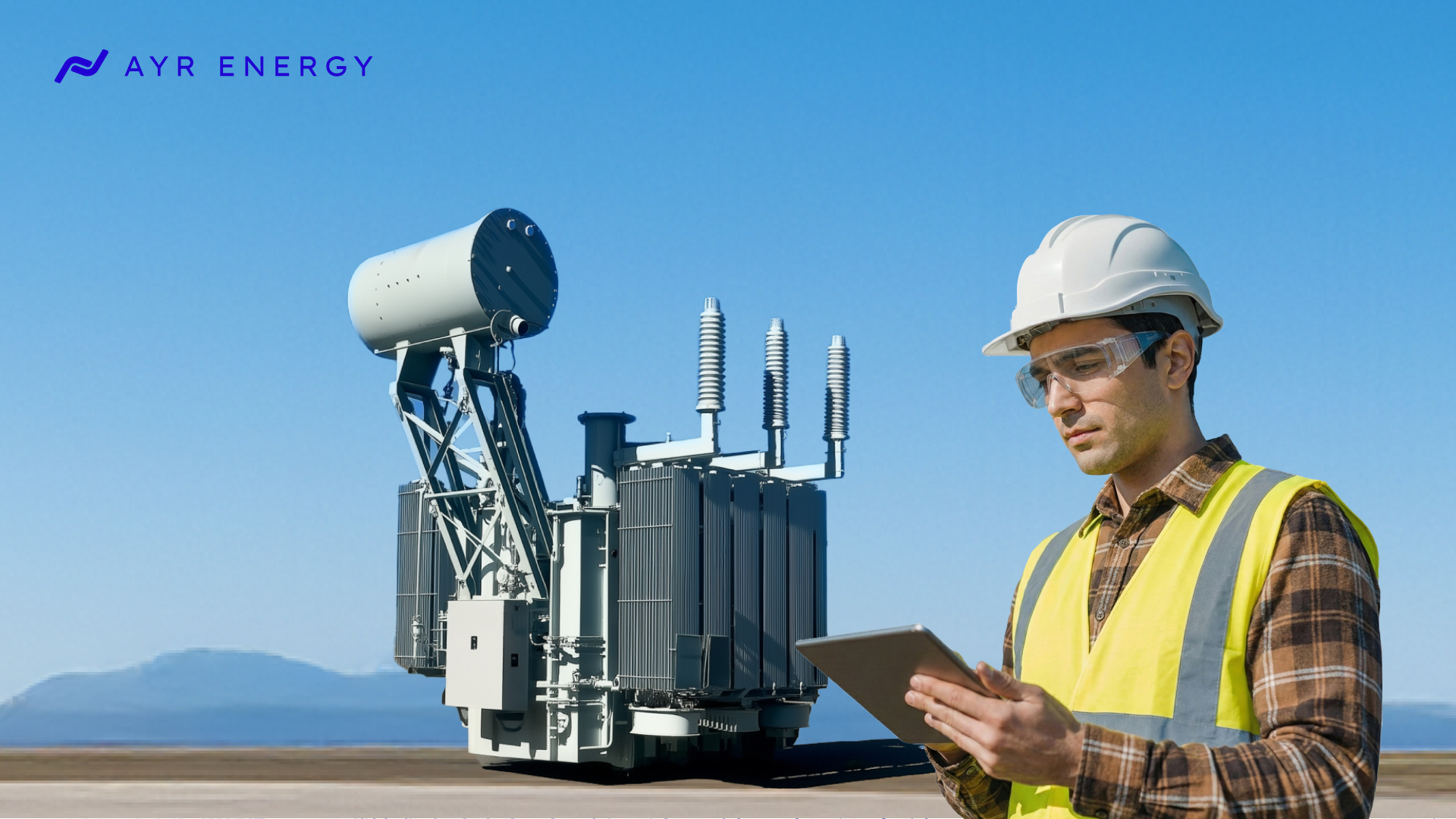
For developers of projects larger than 1.5 MW, procuring custom equipment is a strategic way to satisfy the mandatory Physical Work Test. Ayr Energy supports your compliance strategy with high-voltage infrastructure that meets the strictest IRS standards.
Here is how we help you meet the strict new IRS requirements.
- Our custom-engineered units count as significant physical work, allowing you to lock in solar investment tax credits early.
- We ensure full transparency and compliance with 2026 restrictions to protect your project from audit disqualification.
- Our 12-16 week lead times help you comfortably meet the four-year 'placed in service' deadline.
Secure your Safe Harbor status with Ayr Energy's custom transformer production. Get a quote today.